Guangzhou Aiwo Audio Technology Co., LTD

Guangzhou Aiwo Audio Technology Co., LTD

Digital Amplifier vs Analog Amplifiers in Conference Sound System

2025 05/20

The advantages of digital amplifier over traditional analog amplifiers in conference systems:
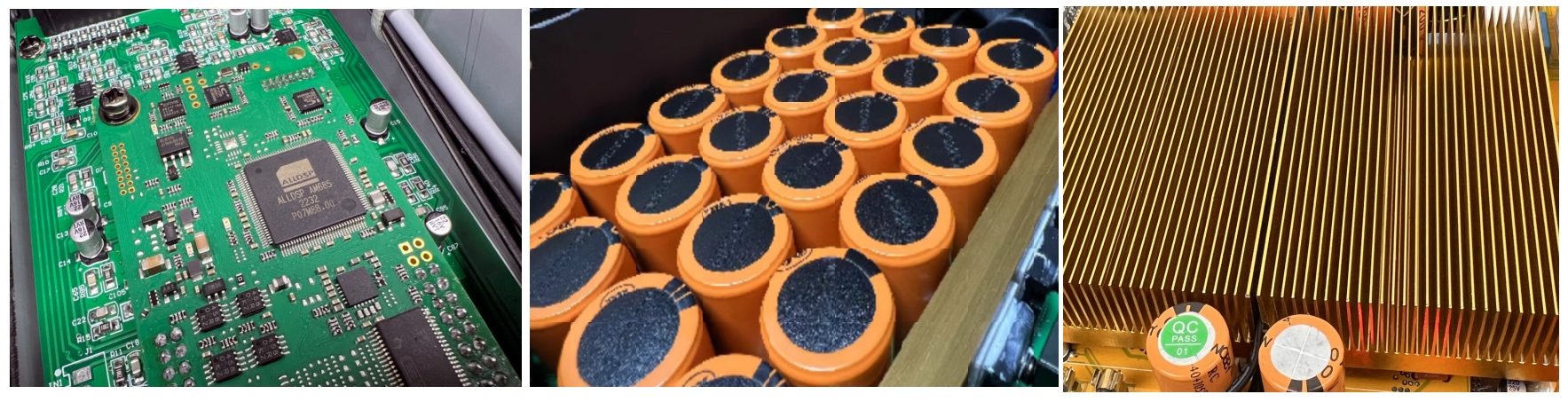
ALLDSP Power Amplifiers 7

1. Audio Processing Precision and Flexibility

  • Digital Amplifiers
    • Utilize DSP (Digital Signal Processing) for precise parameter adjustment (e.g., EQ, compression ratio, delay) with an error margin of <0.1%.
    • Support independent control of multiple channels, allowing tailored settings for different sound sources (e.g., microphones, background music).
    • Example: Real-time adjustment of a 10-band parametric EQ via software to suppress a 500Hz low-frequency hum in a conference room.
  • Analog Amplifiers
    • Rely on potentiometers and analog circuits for adjustment, with lower precision (5–10% error) and interdependent parameters (e.g., volume adjustments may alter tone).
    • Multi-channel designs require additional physical circuitry, increasing costs and risking crosstalk.

2. Dynamic Range and Distortion Control

  • Digital Amplifiers
    • Offer a dynamic range of 110dB+, capable of clearly reproducing both faint whispers and loud applause.
    • Total harmonic distortion (THD) is <0.01%, far lower than the 0.5–1% of analog amplifiers, preserving rich vocal details.
    • Example: In large video conferences, both subtle coughs and passionate speeches are rendered flawlessly.
  • Analog Amplifiers
    • Limited dynamic range (typically 80–90dB) and prone to clipping distortion at high volumes.

3. Echo and Noise Handling Capability

  • Digital Amplifiers
    • Built-in adaptive echo cancellation (AEC) algorithms calculate and eliminate echoes within 64ms, outperforming analog amplifiers’ fixed delay compensation.
    • Support noise gating and automatic gain control (AGC) to dynamically adjust sensitivity based on ambient noise.
    • Example: In open-office conference rooms, air conditioning noise is automatically suppressed to maintain voice clarity.
  • Analog Amplifiers
    • Require external devices (e.g., standalone echo suppressors), increasing costs and limiting effectiveness.

4. Energy Efficiency and Thermal Design

  • Digital Amplifiers
    • Use Class-D switching technology with >90% efficiency, consuming only 1/3 of the power of analog amplifiers at the same output.
    • Generate minimal heat, eliminating the need for large heat sinks and enabling compact 1U rack-mounted designs to save cabinet space.
    • Example: In 24/7 conference systems, digital amplifiers operate silently and reliably for 72+ hours without fan cooling.
  • Analog Amplifiers
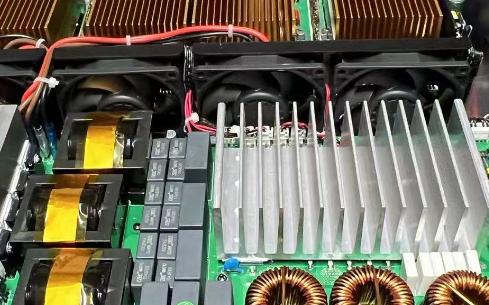
    • Class a amp design achieves ~50% efficiency, requiring large heat sinks and fans that generate noise and consume more power.

5. System Integration and Remote Management

  • Digital Amplifiers
    • Support network control (TCP/IP, RS-485) for remote configuration via mobile apps or central control systems.
    • Built-in SNMP protocol enables real-time monitoring of device status (temperature, power consumption, signal strength) for predictive maintenance.
    • Example: Administrators can switch between “Presentation Mode” and “Video Conference Mode” with one click via a WeChat mini-program.
  • Analog Amplifiers
    • Require manual knob adjustments, making centralized management and automated scene switching impossible.

6. Reliability and Stability

  • Digital Amplifiers
    • All-solid-state circuit design with no mechanical moving parts, achieving an MTBF (mean time between failures) of >100,000 hours.
    • Integrated soft-start, short-circuit protection, and over-temperature protection to prevent damage from operational errors.
    • Example: Digital amplifiers have operated continuously for 5+ years without failure in government emergency command centers.
  • Analog Amplifiers
    • Wear-prone components (potentiometers, relays) require regular maintenance and have higher failure rates.

7. Scalability for Applications

  • Digital Amplifiers
    • Support firmware upgrades for new features (e.g., AI voice enhancement, acoustic field adaptation) without hardware replacement.
    • Compatible with digital audio network protocols (Dante, CobraNet) for seamless integration into distributed conference systems.
    • Example: Existing conference systems can add lip-sync compensation via software upgrades to improve cross-border video conferencing.
  • Analog Amplifiers
    • Fixed functionality; technological upgrades require replacing entire systems.
 
Digital amplifierConclusion: Digital power amplifiers have become the preferred choice for modern conference systems due to their digital processing precision, high efficiency, and ease of integration—particularly in scenarios demanding high sound quality, stability, and intelligent management (e.g., large enterprises, government agencies, international conference centers). Analog amplifiers still have limited applications in low-budget, simple-function small meetings but are rapidly being phased out in professional settings.